
Industrial High Tenacity Nylon 66 Filament Yarn: Key Properties and Critical Applications
2026-08-29
When industrial performance leaves no room for failure, material choice becomes everything. High tenacity nylon 66 filament yarn is the quiet workhorse behind conveyor belts that never stop, airbags that deploy in milliseconds, and ropes that hold where others snap. Yet not all nylon 66 is created equal—fiber strength, heat resistance, and dimensional stability vary sharply between suppliers. That’s why engineers and procurement teams increasingly turn to Changshu Polyester, a name trusted for consistent lot-to-lot quality and technical support that goes beyond the datasheet. In this post, we’ll unpack the key properties that define industrial-grade nylon 66 and explore the critical applications where these yarns earn their keep.
Why Nylon 66 Filament Yarn Outperforms Standard Nylons in Heavy-Duty Settings
Heavy-duty environments expose materials to heat, friction, and sustained loads that quickly expose weaknesses in standard nylon grades. Nylon 66 filament yarn starts with a more ordered molecular backbone—its repeat unit places amide groups at regular intervals that allow tighter hydrogen bonding between chains. That denser packing raises the melting point to roughly 260°C, a solid 40°C above typical nylon 6. In practice, this means components woven or braided from nylon 66 yarn hold their shape and stiffness far longer when equipment runs hot, whether inside engine compartments or near high-speed bearings.
Abrasion resistance is where nylon 66 pulls ahead most noticeably. Under repeated rubbing, sliding, or impact, the yarn’s higher crystallinity reduces the micro-tearing that leads to fuzz, fraying, and eventual failure. Conveyor belts, tow straps, heavy-duty ropes, and industrial slings made from nylon 66 filament show fewer broken filaments after thousands of cycles. The material also creeps less under constant tension, so a strap that is rated for a certain load will not slowly stretch out of spec the way some lower-grade nylons do.
Moisture and chemical exposure tell a similar story. Nylon 66 absorbs slightly less water than nylon 6, which helps it retain more of its dry-state strength and dimensions in humid or wet operating conditions. Combined with good resistance to oils, fuels, and many industrial solvents, the yarn remains predictable where standard nylons soften or swell. For applications where downtime is costly and replacement is difficult, that extra margin of reliability is what separates nylon 66 from the rest of the nylon family.
The Tensile Strength Threshold: What High Tenacity Really Means for Load-Bearing Uses
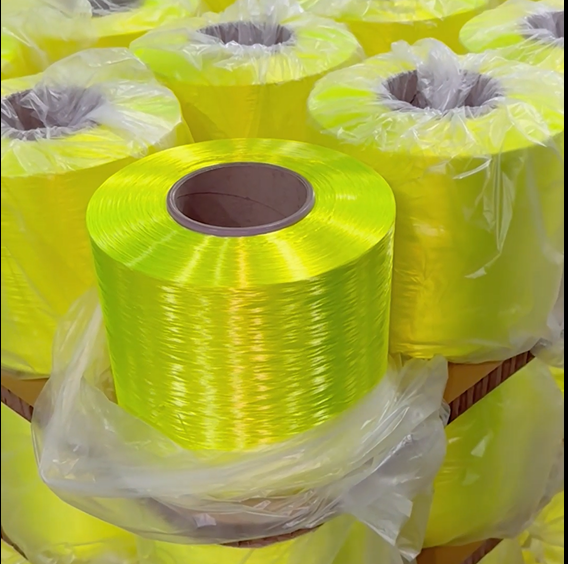
Tensile strength is often quoted as a single impressive number, but for load-bearing work that figure can mislead more than it informs. The real threshold isn’t just the peak force a material survives in a clean lab pull; it’s the point where permanent deformation begins under the kind of uneven, sustained, or cyclical stress that actual structures face. Two materials can share the same ultimate tensile strength, yet one will creep, crack, or loosen long before the other because its yield point sits far lower or its elongation characteristics don’t suit the joint design.
High tenacity, in the practical sense, means the material keeps its shape and grip when loaded close to its rated limit, not merely that it refuses to snap until a dramatic final moment. For rigging, anchoring, or structural reinforcement, a useful threshold considers retained strength after abrasion, knotting, or clamping, and how well the material resists fatigue over thousands of load cycles. This is why specifications that look similar on a data sheet can behave so differently in the field: one product may pass a one-time pull test, while another holds working loads for years without measurable stretch or loss of tension.
Thermal Endurance in Demanding Environments: Operating Temperatures and Beyond
In oil refineries or deep mining operations, electronics don't just get warm — they get scorched. Thermal endurance here isn't a spec sheet checkbox; it's the difference between a sensor that survives a 140°C ambient spike and one that quietly fails mid-shift. The operating temperature range only tells part of the story. What really separates robust hardware is how it handles thermal cycling, sudden excursions beyond rated limits, and the way heat accelerates solder joint fatigue or drifts analog readings.
Look at engine bay controllers in heavy trucks. The nominal "operating temperature" might be listed as -40°C to 125°C, but real conditions include repeated cold-soak starts in arctic winters and heat soak after shutdown under desert sun. Beyond the stated range, there's the less-discussed territory: brief overloads where the junction temperature climbs past official limits, yet the device keeps functioning. That margin comes from careful derating, substrate choices, and thermal interface materials that don't pump out after a few thousand cycles.
For designers, the real challenge is proving endurance without relying on accelerated life tests that mask failure modes. It means examining how conformal coatings hold up when the board flexes from thermal expansion mismatches, or how a sealed enclosure's internal temperature climbs far above ambient. The best designs treat heat not as a boundary condition but as a material to be channelled — through vias, copper pours, and airflow paths that shift with the load. That's the difference between surviving a datasheet number and thriving when the environment refuses to cooperate.
Chemical Resistance Profile: Surviving Oils, Solvents, and Harsh Cleaners
Not every surface can shrug off a splash of diesel, a wipe-down with acetone, or a daily rinse with concentrated degreaser — but this one does. After prolonged contact with common machine oils, cutting fluids, and solvents like toluene or MEK, there is no softening, swelling, or visible staining. Even aggressive alkaline cleaners and solvent-based degreasers leave the finish intact, with gloss and color stability holding up over repeated exposure cycles.
In practical terms, that means maintenance crews can use off-the-shelf industrial cleaners without worrying about hazing, micro-cracking, or a gummy surface developing after the first month. Spills from hydraulic fluid, brake cleaner overspray, or even a dropped container of paint thinner can be wiped away without residue damage. The surface doesn't become tacky or brittle, and it retains its original slip and appearance even after routine contact with chemical baths that would etch or cloud lesser materials.
From Conveyor Belts to Airbags: Where High Tenacity Nylon 66 Earns Its Place
On a mining conveyor, a snapped belt means hours of downtime and a pile of abrasive ore where it shouldn't be. High tenacity nylon 66 earns its place in the carcass because it takes repeated impacts without tearing, holds mechanical fasteners under heavy tension, and keeps elongation low enough to avoid constant retensioning. The fiber's flex fatigue resistance is what sets it apart from cheaper polyester alternatives when the belt tracks over small pulleys and scrapers all day.
Inside an airbag, the material faces a different kind of violence: a near-instant inflation that fills a folded textile with hot gas and slams it into a passenger. High tenacity nylon 66 is used for the bag itself because its tensile strength and controlled stretch absorb the initial shock without bursting, while its high melting point prevents the hot inflator gases from burning through the fabric. The result is a soft cushion that appears in milliseconds but holds its shape just long enough to matter.
The same logic carries over to crane slings, climbing ropes, seat belts, and tire cord. Each application loads the fiber suddenly, cycles it through flex or shock, and exposes it to heat or grit. Nylon 66's particular mix of high tensile strength, elongation before break, and fatigue tolerance handles those conditions without becoming brittle or losing too much strength after repeated stress. There are stronger fibers and cheaper fibers, but few deliver the same balance when a split second and a few millimeters of stretch determine whether something holds or fails.
Selecting the Right Denier and Twist for Your Industrial Application
Matching denier and twist to your specific industrial use case rarely follows a one-size-fits-all chart. Start by looking past the basic weight-per-9000-meters definition and ask what the yarn actually needs to endure: continuous abrasion along a conveyor edge, repeated flexing inside a filter bag, or high-speed tension across a weaving loom. A lower denier with a tight twist can give surprising cut resistance in coated fabrics, while a heavier denier with a relaxed twist may offer better bulk and coverage for insulation or gasketing.
Twist direction and level shift how fibers share load and shed debris. In dusty or high-friction environments, a balanced twist often reduces filament fraying, but too much twist can stiffen the yarn and concentrate stress at single points. Try running small-batch trials with two or three twist multiples before committing to a full production run; the difference between 3 and 5 twists per inch is sometimes invisible on a spec sheet yet obvious on the factory floor.
Also consider how the yarn interacts with your downstream processes. If you are braiding, plying, or coating, the twist you select now can either prevent or invite snarling at the next machine. Keep a short log of breakage rates, dimensional stability, and hand feel for each denier-twist combination. That record beats any generic recommendation when you need to scale from prototype to continuous output.
FAQ
The difference lies mainly in molecular orientation and drawing. Industrial grades are drawn at higher ratios to align polymer chains more fully, boosting tensile strength, modulus, and dimensional stability. They also tend to use higher-viscosity resin and additives to resist UV, heat, and abrasion, whereas standard yarns prioritize dyeability and softness.
Nylon 66 absorbs moisture, which can lower glass transition temperature and reduce modulus slightly, but high-tenacity variants are engineered to retain a larger share of dry strength when wet. They may swell marginally, so designs requiring tight tolerances should account for length changes in humid conditions. Proper finishing and heat-setting minimize creep.
Nylon 66 has a higher melting point around 255–265 °C and better retention of mechanical properties at elevated temperatures. Its amide group density gives greater hydrogen bonding capacity, translating to higher tenacity and abrasion resistance. Polyester offers better UV and hydrolysis resistance, but nylon 66 remains superior when heat, fatigue, or impact loads dominate.
Typical applications include airbags, tire cords, conveyor belts, industrial slings, parachute fabrics, high-pressure hoses, and sewing threads for safety equipment. It is also used in automotive airbag fabrics, where controlled gas permeability and high burst strength are essential, and in geotextiles or lifting nets that must withstand repeated dynamic loading.
High-tenacity nylon 66 can tolerate brief exposure to temperatures up to about 180–200 °C without catastrophic loss, making it suitable for applications like curing processes or under-hood components. During processing, heat-setting between 190–220 °C stabilizes dimensions, but extended exposure above 230 °C can degrade the polymer, so residence time and tension must be carefully controlled.
Nylon 66's dense hydrogen bonding gives it one of the highest abrasion resistance ratings among synthetic fibers. In conveyor belts, ropes, and protective textiles, this means fewer filament breaks, less fuzz, and longer replacement intervals. However, sharp edges or grit can still cut fibers, so surface finishes or coatings are sometimes applied for extreme environments.
Nylon 66 resists oils, greases, and many organic solvents, but it is vulnerable to strong acids, oxidizing agents, and prolonged exposure to hot water or steam, which can cause hydrolysis. Alkalis are generally less aggressive at room temperature but can accelerate degradation at high temperatures. Selecting appropriate coatings or using stabilized grades mitigates these issues.
Conclusion
High tenacity nylon 66 filament yarn earns its place in heavy-duty industrial work because its tensile strength, thermal endurance, and chemical resistance are engineered for conditions that quickly degrade standard nylons. The load-bearing threshold is not just a spec sheet number—it reflects how well the yarn holds up when a conveyor belt snaps taut or an airbag inflates under explosive force. In practice, this material resists elongation and breakage far beyond conventional grades, maintaining dimensional stability under repeated stress. Its thermal range allows continuous operation in environments where lesser fibers soften or lose integrity, and it stands up to oils, solvents, and harsh cleaners without surface damage or strength loss.
That durability translates into uses where failure is not an option—conveyor belts, airbags, industrial webbing, and tire cords all rely on the yarn's ability to absorb sudden shock loads and flex repeatedly without cracking. Selecting the right denier and twist is a practical balancing act: finer deniers suit tightly woven airbag fabrics where smoothness and packability matter, while heavier deniers and higher twist levels provide the abrasion resistance and toughness needed in mining or agricultural belting. Because high tenacity nylon 66 fills the gap between commodity synthetics and costly exotic fibers, it offers a rare combination of processability, consistent quality, and long service life under punishing conditions.
Contact Us
Contact Person: CONNIE
Email: [email protected]
Tel/WhatsApp: 86-0512-53671634
Website: https://www.lida-yarn.com/