

Metal Buckle Manufacturer Tips for Selecting the Right Hardware Accessories
2026-11-16
Choosing the wrong metal buckle can quietly unravel even the best-designed gear—so how do you separate reliable hardware from cheap imitations? As a leading metal buckle manufacturer, Kingming has watched countless projects stall over overlookable details like finish adhesion, load tolerance, and edge burrs. This guide strips away the guesswork, giving you practical, field-tested tips for selecting hardware accessories that hold up under real-world stress.
Why the Cheapest Buckle Often Costs More Later
At first glance, a budget buckle seems like a smart way to save a few dollars on a belt, bag, or piece of outdoor gear. But that savings often evaporates quickly once the buckle is put to real use. Cheap alloys and thin plating wear through in weeks, leaving jagged edges that snag fabric or scratch skin. The spring mechanism—if there even is one—loosens after a few dozen cycles, so the belt no longer stays cinched when you need it most. Before long, you are buying a replacement, and the total cost quietly surpasses what a well-made buckle would have set you back from the start.
The hidden costs go beyond just buying twice. A failing buckle can damage the strap it is attached to, chewing through leather or nylon as it shifts and bites under load. If the buckle fails during a hike, a commute, or a work shift, the inconvenience multiplies—imagine a tool belt dropping mid-task or a backpack strap letting go on a crowded train. Repairing or replacing the whole item, not just the buckle, turns a small upfront saving into a recurring expense. Quality buckles, by contrast, are machined or forged from solid brass, stainless steel, or high-grade acetal, and their springs are designed for thousands of cycles without fatigue.
There is also a less obvious cost: your own attention. Every time you have to readjust a slipping strap or fiddle with a sticky release, you lose focus and patience. Over months of daily use, those seconds add up, and the frustration wears on you more than the money ever did. A dependable buckle disappears into the background, doing its job silently. The cheapest option rarely offers that kind of quiet reliability—it demands constant small repairs and mental energy. When you factor in replacement parts, damaged gear, lost time, and the low-grade irritation of a product that never quite works right, the inexpensive buckle often becomes the most expensive choice you can make.
Match the Alloy to the Job, Not Just the Looks
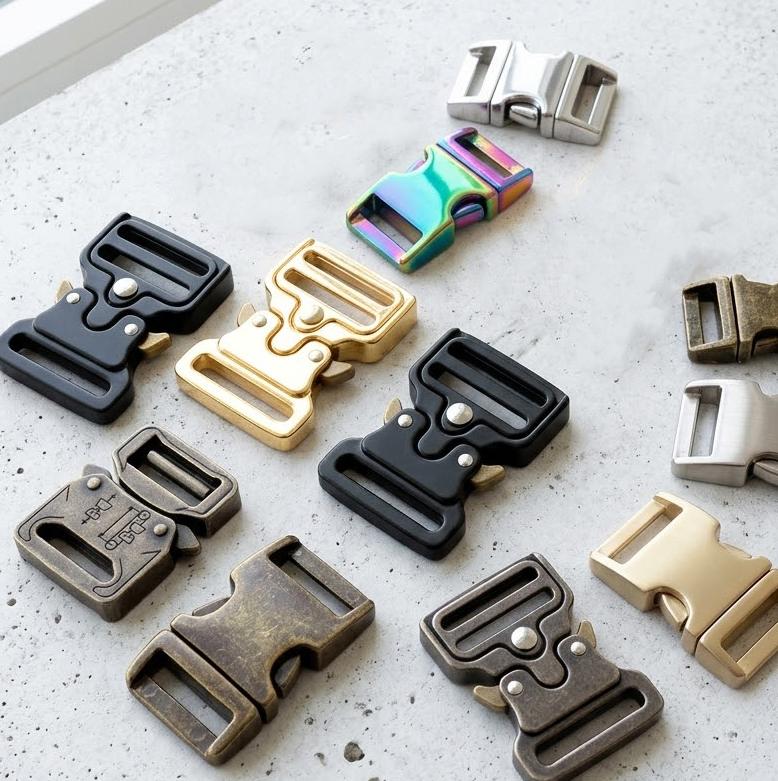
Choosing a metal based purely on its surface shine rarely ends well. A polished stainless steel part might look great on a workbench, but if it's going into a salt-spray environment, you'll be replacing it within months. The real question is what the component actually has to survive: constant friction, sudden impacts, exposure to chemicals, or extreme temperature swings. Each alloy has a specific personality under stress, and matching that personality to the job saves money and headaches later.
Take aluminum alloys, for instance. A 6061 alloy machines beautifully and resists corrosion, making it a go-to for brackets and frames. But if you need something to take repeated shock loads, a 7075 alloy—while harder to work with—will hold up far better. Similarly, tool steels like D2 excel at cutting edges but can crack under heavy impact, whereas S7 absorbs shock without chipping. The difference isn't cosmetic; it's about how the material's internal structure responds to the exact forces you're throwing at it.
The same logic applies to fasteners and fittings. A brass fitting looks classic on a fuel line, but if that line carries ethanol-blended gasoline, the zinc in the brass can leach out and cause leaks. Switching to a nickel-plated steel or a compatible stainless alloy solves the problem before it starts. Before you fall in love with a metal's color or finish, write down the actual working conditions—load, temperature, chemical exposure, vibration—then pick an alloy that shrugs those off without drama.
Hardware Finishes That Fail First in Humid Climates
In humid coastal air, the first finishes to go are usually the ones that rely on a thin plating over steel or pot metal. Bright polished brass and chrome may look indestructible, but they develop tiny pinholes and edge wear almost immediately. Once moisture slips under the plating, blisters form and the finish starts peeling away in sheets, leaving dull gray patches behind.
Oil-rubbed bronze and matte black are equally vulnerable when they are produced with a tinted lacquer instead of a true chemical patina. The clear topcoat absorbs moisture unevenly, especially around knobs and handles where fingers make constant contact. That is why you will see light chalky spots or greenish streaks appearing around the edges long before the center of the hardware shows any wear.
Even some stainless steel formulations struggle in prolonged humidity. Low-chromium grades such as 18-0 can develop tea staining when salt-laden condensation settles on the surface. For doors, cabinets, and bath fixtures exposed to damp air, PVD-bonded finishes or solid unlacquered brass tend to hold up far better because they either seal the base completely or form a stable oxide layer instead of flaking.
Load Ratings Alone Won’t Save a Badly Designed Keeper
A keeper that stamps a hefty load rating on the box can still fail the moment the geometry works against it. Think of a latch whose jaw opens just a few degrees too wide under tension, or a bolt that necks down sharply behind the threads. The number on the spec sheet assumes an idealized load path, but real installations rarely hand you that. Off-axis pulls, vibration, and even slight misalignment redirect stress into corners the designers never reinforced.
What matters more is how the component manages that stress before it reaches the breaking point. A well-designed keeper spreads the load across a broad shoulder or uses a gradual radius instead of a sharp notch. Cheap castings often hide porosity and tiny cracks that a tensile test won't catch, because the test coupon is flawless and the production part is not. Once fatigue sets in, that impressive static rating means very little.
So before you trust a keeper based on its advertised tons, look at the actual shape, the transition zones, and the quality of the material. A lower-rated part with clean lines and smart reinforcement can easily outlast a brute-force design that only looks strong on paper.
Pairing Metal Buckles With the Wrong Webbing Width Quietly Fails
A metal buckle that feels slightly loose on the webbing often gets dismissed as "good enough." The extra space lets the strap shift sideways under tension, concentrating force on one edge instead of spreading it across the full width. That uneven load can make the webbing roll, twist, or saw against the buckle frame, degrading the fibers long before any visible tear shows up.
When the width mismatch goes the other way—webbing too wide for the slot—the edges get pinched and folded to force it through. The buckle then bites into the creased fabric, creating stress risers at exactly the points where stitching or heat-sealing is weakest. Most failures happen quietly: a gradual fray near the hardware, a subtle loss of grip, then a clean snap under a load that a properly matched pair would have held without complaint.
Salt Spray Hours vs. Real World Sweat and Rain
Treating salt spray hours as a direct stand-in for real-world sweat and rain exposure ignores how different these environments actually are. A standard salt fog test blasts a fine mist of 5% sodium chloride at a steady 35°C, but human sweat is a cocktail of urea, lactic acid, ammonia, and varying salt concentrations that shifts with diet, stress, and skin location. Rainfall, on the other hand, may start nearly pure but picks up sulfates, nitrates, and urban grime as it falls. The narrow chemistry of a salt chamber simply does not replicate that messy mix.
Even the physical rhythm matters. Salt spray testing keeps surfaces continuously wet, while real sweat dries into concentrated salt patches that can sit against metal or coatings for hours. Rain alternates with sun and wind, creating repeated wet-dry cycles that drive corrosion deeper into pores and crevices. Add in temperature swings, UV exposure, and abrasion from clothing or skin contact, and you get a stress profile that no single constant-spray cabinet can reproduce.
A product that survives 96 or 200 salt spray hours may still tarnish or pit after a summer of heavy perspiration or a season of acidic rain. The hour count is a useful screening tool for comparing finishes under identical lab conditions, but it is not a promise of real-world longevity. For better predictions, look for cyclic corrosion tests that alternate salt fog with drying and humidity, or simply rely on long-term wear reports from actual users.
FAQ
Look at the edge finishing and how consistently the buckle seats into the strap or webbing. Small burrs or uneven plating often show whether the factory controls its polishing and coating steps, not just the stamping.
Brass generally offers better corrosion resistance and a more premium feel, but zinc alloy can be perfectly serviceable with a proper electroplated finish. Ask for salt spray test results rather than relying on material alone.
Yes, request the breaking strength values from their own tensile tests and compare the test fixture setup. A buckle tested with a flat webbing loop versus a rounded pin can differ noticeably, so make sure you are comparing like for like.
Usually when your order volume can absorb the mold or die cost and you need a specific shape or logo that stock options cannot provide. If you are prototyping, ask whether they can do a low-run CNC or cast sample before committing to full tooling.
Look into black nickel or matte black epoxy coating rather than plain black paint. Ask for an adhesion test or a sample you can rub with a key to see how the finish behaves before chipping.
Give them your webbing thickness and strap width, then see if they ask about the inside bar dimensions or recommend an alternative slot size. A good supplier will flag fit issues instead of just saying yes to everything.
It depends on complexity and whether dies already exist. A simple logo engraving may take three to four weeks, while a fully custom shape with new casting molds can run six to eight weeks or more. Always confirm whether finishing is included in that timeline.
Yes, if the product may touch skin for long periods. Ask for nickel-free plating or a clear lacquer barrier, and request a lab test report confirming compliance with relevant EU or US limits before production.
Conclusion
Choosing metal buckles based solely on price is a trap many buyers fall into, only to face premature rust, frayed webbing, or load failures later. A cheap buckle often uses brittle alloys or thin plating that cracks under daily stress, while a well-matched alloy—such as zinc for light-duty straps or stainless steel for marine gear—performs reliably without unexpected replacement costs. Finishes matter just as much: in humid climates, nickel or decorative coatings tend to blister and peel within months, leaving the base metal exposed to corrosion. Instead, look for electro-polished stainless or heavy-duty powder coating that can handle sweat, rain, and coastal air.
Beyond material and finish, real-world testing goes beyond lab spec sheets. Salt spray hour ratings give a rough idea, but actual sweat, sunscreen, and repeated wet-dry cycles cause different failure patterns than a controlled fog chamber. Even a buckle with a high load rating can fail if the keeper bar is poorly designed—misaligned or too thin—allowing the strap to slip or tear under tension. Pairing the buckle with the wrong webbing width is another quiet killer: a 25mm buckle on 20mm webbing creates uneven stress points, while a 38mm buckle on 25mm strap lets the hardware shift and chew the fabric. Before finalizing any order, test the whole assembly under realistic conditions, not just individual components.
Contact Us
Contact Person: Jamie Zeng
Email: [email protected]
Tel/WhatsApp: +86 13728219269
Website: https://www.kmhardware.com