
ODM AGV Compatible Pallets: Streamlining Automated Material Handling with Custom Solutions
2026-06-27
In modern warehouses, automated guided vehicles (AGVs) are reshaping material flow—but their efficiency often hinges on a simple yet critical component: the pallet. Off-the-shelf options rarely fit the precise demands of robotic systems, leading to costly misalignments and downtime. That’s where tailored ODM AGV compatible pallets come into play. Designed from the ground up to match your automation setup, they eliminate guesswork and boost throughput. At Lanyuda, our custom solutions bridge the gap between generic pallets and seamless AGV integration. Curious how the right pallet can transform your operation? Read on.
Why Standard Pallets Often Miss the Mark in Automated Setups
Automation demands a level of consistency that most off-the-shelf pallets simply can't provide. These pallets were originally designed for forklifts and human labor, where a slight warp or a missing chunk of wood is a minor annoyance. In a robot-driven world, those tiny defects become major disruptions. The margin for error shrinks dramatically when machines are doing the lifting and moving without the nuance of a human operator.
You'll often see wooden pallets with splinters, uneven boards, or nails sticking out—things that wreak havoc on automated systems. A conveyor belt doesn't care if a pallet snags; it just stops, and suddenly an entire production line is held hostage by a ten-dollar piece of lumber. Even the dimensions, supposedly uniform, can vary enough to throw off a robotic arm's calibration, leading to dropped loads or costly rework.
This is why more facilities are moving away from generic pallets and toward purpose-built alternatives. The upfront cost stings, but the math becomes simple when you compare it against the accumulating losses from downtime, damaged product, and the constant babysitting of finicky automation. Standard pallets do the job in a warehouse, but in an automated setup, they often create more problems than they solve.
Key Design Elements That Make a Pallet Truly AGV-Ready
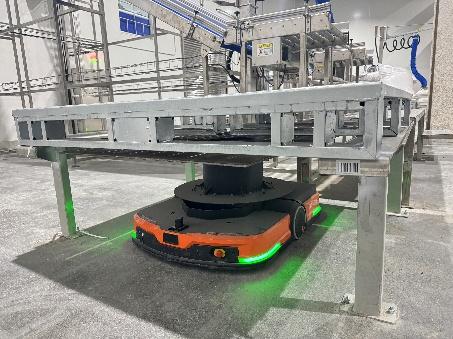
Precision in every dimension matters more than you might expect. An AGV relies on consistent pallet dimensions to engage without hesitation or error. The bottom deck needs a completely flat, clean surface so suction cups or forks can lock on securely; even a slight warp or protruding nail head can throw off alignment and halt the entire line. Key areas like fork pockets must have reinforced edges and exact entry chamfers to guide the AGV's tines smoothly, compensating for minor positioning variances without causing jolts.
Material choice directly impacts both durability and energy efficiency. Pallets made from high-density polyethylene or reinforced composites withstand the repetitive clamping and lifting cycles without splintering or deforming, unlike typical wood that gradually wears down. Weight is a quiet but critical factor—lighter pallets reduce battery drain on electric AGVs, extending run times between charges, while still offering enough heft to stay planted when the vehicle decelerates. Some designs embed steel bars only where stresses concentrate, keeping the overall mass low but the life span high.
Beyond the physical structure, visibility to the robotic system is non-negotiable. Built-in RFID slots or molded-in QR code panels give the AGV instant load identification, so it knows what it’s carrying and where to deliver without human input. Reflective strips or unique color contrasts along the base help onboard sensors judge distance and orientation accurately, especially in dimly lit warehouses. Anti-slip inserts on the top deck prevent loads from shifting during sudden turns, combining safety with the steady precision that automated guided vehicles demand.
Beyond Off-the-Shelf: The Advantage of ODM Customization
The standard route of picking a ready-made product often leads to a sea of sameness. Off-the-shelf solutions promise speed and convenience, but they rarely align perfectly with a brand's vision or operational realities. There's always that one feature you wish you could tweak or a material you'd rather swap out. That gap between what's available and what your market actually needs can quietly erode your edge.
ODM customization flips this script entirely. Instead of pouring your identity into a pre-shaped mold, you collaborate with manufacturers to bring a distinct product to life. You get to define the specs, from the core components to the finishing touches, ensuring the result isn't just another listing but a genuine reflection of your brand. It turns the manufacturing table into a creative workshop where your input drives the output.
This approach doesn't just solve the uniqueness puzzle—it also streamlines the journey from idea to shelf. By working directly with an ODM partner, you sidestep the trial-and-error phase that often comes with ground-up R&D. The expertise built into the factory's existing platforms becomes a launchpad, accelerating timelines and reducing costs without sacrificing originality. In a market that rewards the bold and the fast, that's a quiet but powerful advantage.
How Tailored Pallets Smooth Out Material Flow
In any production environment, the movement of materials can make or break efficiency. Generic pallets often force teams into awkward loading patterns or leave parts vulnerable to damage. That’s where tailored pallets come in—they’re designed to match the exact dimensions and weight distribution of your goods, so everything stays put and moves exactly as it should. No more chaotic stacks, just a steady, predictable flow from station to station.
A pallet that’s built specifically for your product line does more than just hold things. It integrates with automated conveyors and robotic handlers without the usual hiccups—no jamming, no misalignment, no slowdowns. Because the design accounts for your facility’s specific handling equipment, materials transition seamlessly between processes. The result is a rhythm that keeps production lines running at full tilt, without those nagging interruptions that eat into your day.
Beyond the mechanics, tailored pallets also cut down on the hidden drains. Less time spent reorganizing loads, fewer damaged items, and a drastic reduction in the need for makeshift padding or wrapping. This isn’t just about speed; it’s about reliability. When every component moves at a consistent pace, you can schedule work accurately and respond to demand without the usual stress. In practice, a well-fitted pallet turns material flow from a headache into a background hum—one that quietly powers your throughput without you having to think about it.
Picking the Right Materials for Long-Haul AGV Performance
When designing automated guided vehicles built to shuttle loads across sprawling factory floors, the conversation often defaults to motors, sensors, and software. But the real endurance heroes are the materials you select, because a long-haul AGV is only as reliable as the structural components that carry the burden mile after mile. Aluminum might look tempting for its weight savings, yet repeated stress cycling can lead to micro-fractures that quietly eat away at uptime. High-strength steel, blasted and powder-coated, brings that stubborn resistance to deformation that keeps chassis alignment true when the route never seems to end. It’s not about picking the lightest or the cheapest—it’s about reading the fatigue life curves and betting on the metallurgy that laughs at repetitive impact.
Polymer choices are no less critical, especially where friction turns into heat and noise. A polyurethane drive wheel compound that feels perfectly grippy during a demo can transform into a squealing, rapidly degrading headache once it’s pounding concrete 18 hours a day. The trick lies in matching the durometer not just to the floor surface but to the expected duty cycle—softer materials absorb vibration but wear faster, while harder grades transmit every bump straight into the bearings. And if you’re running in cold storage or foundry-adjacent aisles, the entire equation changes: a material that performs at room temperature might become brittle or gummy when the thermometer swings. That’s why seasoned engineers keep a library of samples with scribbled notes on wear patterns, rather than trusting a datasheet alone.
Beyond the frame and contact surfaces, the quiet killers of material failure hide in joints, fasteners, and enclosures. Vibration loosens what corrosion hasn’t already attacked, turning a minor bracket into a cascade of misalignment. Specifying stainless hardware in washdown areas, or using anaerobic adhesives on threaded assemblies, feels like a small detail, but it’s the difference between a fleet that runs 50,000 hours with basic inspections and one that needs constant attention. The best long-haul AGV isn’t the one with the flashiest navigation—it’s the one that forgets it ever had a material problem, because someone took the time to imagine every stress, every temperature shift, and every chemical drip it would ever meet.
Seeing the Difference: Real-World Shifts After Switching to Custom Pallets
Warehouse floors once cluttered with misfit pallets now hum with a quieter, more deliberate rhythm. Forklifts glide between racks without the familiar screech of wood scraping metal, and the stack patterns that used to wobble under uneven loads now hold steady through multiple shifts. The difference isn’t decorative—it’s functional. When pallets match the exact dimensions of the products they carry, the wasted air between boxes disappears. Narrower aisle spacing becomes possible, and that extra square footage quietly translates into storage for an entire SKU category that previously needed off-site overflow space.
The shock comes in the shipping bay, where the weekly tally of returned goods starts to drop without fanfare. Fragile edges that used to snap during transit now ride snug against tailor-made supports, and the shrink wrap that once cocooned every pallet like a desperate bandage gets used more sparingly. Drivers no longer waste time repackaging at the dock, and retailers stop claiming chargebacks for crushed corners. It’s a slow, cumulative reprieve—one that shows up in the ledger not as a grand event, but as a steady reduction in replacement orders and complaint tickets.
Out on the retail floor, the visual shift catches the eye before any operational metric can register it. Uniform pallet footprints create neat lines during stocking hours, and the seasonal displays that once looked hurriedly assembled now appear deliberate. Employees handle them faster, with less second-guessing, because every box has its place by design rather than by improvisation. The transformation from generic to custom isn’t announced in newsletters or pinned as a corporate initiative; it’s felt in the absence of minor daily frictions that once blended into the background noise of doing business.
FAQ
ODM AGV compatible pallets are custom-designed platforms built specifically to integrate with automated guided vehicles. Unlike generic pallets, they're engineered with precise dimensions, docking features, and weight distribution to match exact AGV specifications, eliminating the mismatches and instability often seen with off-the-shelf options.
Every warehouse setup has unique workflows, payload types, and AGV models. Custom pallets are built around these variables—considering factors like load geometry, sensor clearance, and pick-up points—so they fit seamlessly into existing systems without forcing compromises that could slow down operations or damage goods.
They reduce handling errors and downtime by ensuring perfect alignment with AGV forks, conveyors, and racks. Since they're designed for the specific automation environment, loading and unloading becomes faster, sensors read reliably, and the entire flow from storage to production line runs with fewer interruptions.
Material choice depends on use case—heavy-duty steel for automotive or industrial loads, reinforced plastic for hygiene-sensitive sectors like pharmaceuticals, and sometimes aluminum for lightweight yet strong solutions. The common thread is durability matched to the specific demands of the AGV system and environmental conditions.
Absolutely. ODM pallets are often designed as drop-in enhancements for current fleets. By analyzing the existing AGV interface and operational constraints, manufacturers can produce pallets that work with legacy models, extending the life of your automation investment without a complete overhaul.
Key features include standardized or bespoke docking interfaces, precisely located guide slots, RFID tag mounts, and non-slip surfaces tailored to the AGV's gripping mechanism. Some designs also incorporate chamfered edges and alignment blocks that compensate for minor positional variances during pick-up.
Although upfront engineering may be pricier, ODM pallets eliminate ongoing costs from product damage, pallet jams, and AGV wear caused by poor fit. Plus, you avoid the expense of modifying your AGVs or workflow to suit generic pallets—over time the tailored solution often pays for itself.
Logistics, automotive manufacturing, food and beverage, and electronics assembly see major gains. Essentially any sector where precision, hygiene, or heavy payloads are critical benefits, because the pallets can be optimized for cleanroom standards, extreme weights, or high-speed robotic interactions.
Conclusion
Standard pallets rarely survive the shift to automated environments without causing friction. Warped boards, inconsistent dimensions, and vaguely placed blocks might go unnoticed by forklift operators but will trip up an AGV’s sensors and grippers. A pallet that rocks a few millimeters or has a splintered corner can trigger endless recovery cycles, erasing any cycle-time savings the automation promised. This is where ODM takes over: instead of asking the automation to work around the pallet, the pallet is built around the specific motion profile, docking tolerance, and load shift limits of each AGV fleet. Features like precisely routed fork pockets, radiolucent zones for RFID transparency, and anti-slip inserts matched to the arm’s contact pressure turn a basic platform into a reliable interface. Customization lets you hard-code repeatability into the unit—something no off-the-shelf option can deliver when every millimeter counts at 2 m/s.
The impact rolls far beyond the dock. When pallets are dimensionally matched to your automated lanes, buffer zones shrink and accumulation logic becomes predictable. Material flow stops lurching and starts streaming, especially in multi-AGV systems where hand-offs need identical pick faces. One electronics manufacturer we worked with eliminated 11 minutes of robot idle time per shift simply by switching to custom pallets that presented parts at a consistent height and overhang. Material selection plays an underappreciated role here: glass-filled nylon hybrids cut weight without sacrificing stiffness for long-haul cycles, while stainless steel inserts at wear points let the same pallets run through washdown stations and freezer tunnels without breakdown. Watching a fleet glide through a facility without those familiar jolts and error beeps isn’t just a maintenance win—it changes what the entire line can output, shift after shift.
Contact Us
Contact Person: Johnny
Email: [email protected]
Tel/WhatsApp: +86 18151010686
Website: https://lydstorage.com