

OEM Oil-Filled Pressure Gauge Benefits and Selection Guide for Industrial Use
2026-11-19
Pressure gauges rarely get much attention until a reading drifts or a process goes sideways. For industrial teams sourcing OEM oil-filled pressure gauges, the right choice quietly extends equipment life, steadies needles under vibration, and cuts down on premature replacements. This guide breaks down what actually matters when selecting these gauges for demanding environments—from case fill fluid and mounting styles to accuracy classes—so you can specify with confidence. We also look at how HONGSEN approaches oil-filled gauge design for OEM applications where consistency and long service intervals are non-negotiable.
Why Oil-Filled Gauges Outlast Dry Gauges in Harsh Conditions
In many field and process applications, a dry gauge starts at a real disadvantage because its internal movement is fully exposed to whatever the surrounding conditions throw at it. Filling the case with glycerin or silicone oil creates a constant lubricating film across the pinion, sector, and linkage. That film reduces friction in exactly the places where dry gauges tend to develop play, keeping the needle steady and preserving accuracy far longer.
Vibration and pressure pulsation are also much harder on dry movements. With nothing to slow the pointer down, every pump stroke or pressure spike sends sharp, repetitive loads through the gear teeth. In an oil-filled gauge, the fluid resists sudden motion and lets the pointer settle smoothly instead of hammering. The result is less mechanical shock, fewer loose parts, and a noticeably longer working life on compressors, hydraulic lines, and other high-cycling equipment.
Moisture and contaminants make the difference even more obvious over time. A dry gauge can breathe with temperature changes, pulling in humid air that fogs the lens and gradually corrodes the internals. An oil-filled case seals the movement away from damp, salty, or chemical-laden air and helps moderate temperature swings around the tube. That protection keeps the mechanism clean, stable, and responsive well after a dry gauge in the same location would have seized or become unreadable.
Matching Gauge Construction to Real Operating Conditions
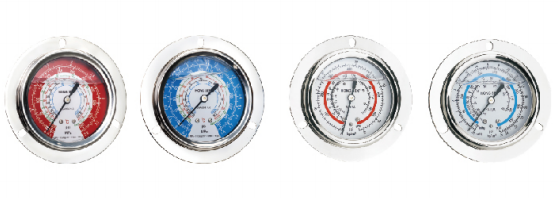
Gauge selection often starts on paper with pressure ranges and dial sizes, but actual plant conditions quickly expose mismatches. A gauge built for clean, dry air may struggle once it faces vibration, pulsation, or corrosive atmospheres. Instead of treating the instrument as a generic component, it helps to compare construction details such as case material, fill fluid, movement type, and connection location against what happens during start-up, normal run, and shutdown.
In high-vibration areas, a solid-front case with a dampened movement or liquid fill can reduce needle flutter and internal wear. Where process fluids attack brass or copper alloys, stainless steel internals or a diaphragm seal can change the expected service life well beyond the nominal accuracy class. Temperature swings introduce another layer: a closed case with a blowout disc may fog or pressurize, shifting readings. Matching gauge construction means reading the environment first and specifying the gauge second.
Real operating conditions rarely stay constant. A gauge may sit idle for weeks, then experience rapid thermal or pressure cycling. Construction choices like welded joints, case venting, and lens retention become deciding factors. The aim is not just a gauge that reads correctly on day one, but one that remains legible and safe under the specific stresses of the installation.
How Liquid Damping Improves Readability and Reduces Wear
In analog instruments, the moving element often picks up excess energy after a sudden change in input. A needle can swing past the true value several times before settling, forcing the operator to wait or mentally average the motion. Liquid damping introduces a controlled viscous drag that absorbs that surplus motion almost immediately. The pointer glides to its final position and stays there, removing the guesswork from quick readings.
That same damping fluid also forms a thin film between pivots, bearings, and other closely fitted parts. Instead of allowing hard metal-to-metal contact during abrupt stops or reversals, the liquid spreads the force over a larger area and slows the relative movement. The result is less scuffing, less loosening at the pivot, and fewer tiny particles that accelerate future wear.
A practical side benefit shows up in field use. Portable gauges and vehicle instruments experience constant vibration that can make an undamped pointer chatter and polish contact points into flat spots. By keeping motion deliberate rather than reactive, liquid damping preserves both the readability of the display and the mechanical integrity of the assembly without requiring frequent recalibration.
Mounting, Connection, and Sizing Details That Get Overlooked
Most mounting mistakes do not come from picking the wrong bracket, but from forcing a flat part onto a surface that is not flat. A small amount of shimming under one foot can prevent the housing from twisting once the bolts are tightened, which is when the rotor or shaft begins to bind. The sequence of bolt tightening matters more than final torque on many pump and motor flanges, especially where a thin gasket is involved. Pull the bolts down in a crossed pattern and check alignment again after the last pass, because even a rigid base moves slightly as it settles.
Connections fail where the drawings stop being precise. A threaded port may have the right nominal size, but the thread form can be NPT, BSPT, or metric, and a single mismatch will feel tight before it seals. Where hoses attach to moving parts, leave enough slack for flex, but not so much that the hose rubs against a sharp edge during normal vibration. For electrical connectors, the strain relief often gets tightened before the cable is routed, which pulls the pins sideways and creates an intermittent connection that is hard to trace later.
Sizing rarely matches the catalog dimensions once the full assembly is in place. A cylinder with a stroke that fits on paper may collide with a guard or a bracket when the rod end and clevis are included, so check the full retracted and extended lengths with the actual attachments installed. Flow ports sized by thread diameter alone can undersize the internal passage, especially in quick-connect couplings and swivel fittings. Leave a little more clearance than the maintenance manual suggests wherever someone will need to reach a filter, drain plug, or adjustment screw with a tool.
OEM Customization Choices That Simplify Assembly and Inventory
Assembly lines slow down when a supposedly standard component arrives with the wrong connector orientation or an unlabeled cable set. Our OEM customization menu was built to remove those small decisions from the bench. You can specify cable exit direction, mounting inserts, pre-programmed identifiers, and even the torque marking on fasteners before the unit is packed. That means the person on the line follows a single work instruction instead of improvising around a generic part.
Inventory pressure usually comes from managing a base model plus loose accessory kits that never match actual demand. By tying each variant to a dedicated part number with the right brackets, firmware defaults, and labeling already included, the stockroom only carries what the build plan will consume. Reordering becomes more mechanical, and the gap between what purchasing buys and what production needs shrinks noticeably.
There is also a quieter benefit: fewer internal handoffs. When engineering, procurement, and assembly all reference the same locked configuration, the daily hunt for revision notes or substitute fasteners fades. The customization choices stop being a sales talking point and start acting like a production control—one that keeps both the line and the shelf from accumulating surprises.
Comparing Long-Term Costs Beyond the Initial Gauge Price
A low sticker price on a gauge can feel like a small victory, but that number rarely reflects what the device will actually cost over its working life. Frequent calibration, faster drift, and shorter replacement cycles quietly turn a bargain into a repeated expense. Once you add the labor for each service visit and the downtime while the instrument is out of position, the true price starts to look very different.
The more useful comparison runs over three to five years, not just the day of purchase. A gauge that holds its stability longer can look expensive on the shelf but still come out ahead once you count calibration visits, replacement parts, and the production time lost while the instrument is out of service. A few hundred dollars saved at the start loses meaning if the lower-cost unit drifts twice as often or fails during a critical batch.
Some of the heaviest costs never show up on a purchase order. Rework from questionable readings, extra time spent cross-checking measurements, training new staff on temperamental equipment, and even inventory for spare units all add up. If a vendor cannot provide clear drift data, expected service life, or calibration intervals, that gap in information should be treated as a cost in itself.
FAQ
On hydraulic systems, pump ripple and valve shifts create constant needle flutter that makes dry gauges nearly impossible to read. Glycerin or silicone fill dampens that motion, so the needle settles quickly and operators can check pressure at a glance instead of trying to average a blur.
The fluid surrounds the bourdon tube, movement, and linkage, which keeps moisture, salt spray, and process vapors from reaching those parts. It also lubricates moving surfaces. In food plants or coastal sites, that extra barrier cuts down on corrosion and seizure compared to an unfilled case.
Glycerin is the common default because it damps well and costs less, but it stiffens in very cold weather. Silicone holds a more stable viscosity across a wider temperature range and works better outdoors or in freezer rooms. For high-temperature service, some OEMs use halocarbon or other specialty oils, so the operating environment should drive the choice.
A 2.5-inch or 4-inch dial covers most direct-mounted pump and compressor applications. Smaller 1.5-inch gauges are fine for compact pneumatic panels, but once the gauge sits more than arm's length away or vibration is severe, the larger face and heavier case make readings easier and more reliable.
Brass works well with clean air, water, and many oils, but it degrades with corrosive chemicals, saltwater, or fluids that attack copper alloys. Stainless steel internals and case are worth the extra cost when the gauge must handle aggressive media, frequent washdowns, or outdoor exposure where a brass movement would fail early.
The fill fluid expands and contracts with temperature, which changes case pressure and can shift the reading slightly. A ventable fill plug or a pressure-compensating diaphragm lets excess case pressure escape without letting moisture in. In applications with day-night cycles or process heat, specifying a vented or compensated gauge keeps zero error within acceptable limits.
A panel-mount gauge with a back or lower connection usually works best because it keeps the pressure line behind the panel and the face flush with the front. In tight spaces, a center-back mount with a U-clamp or front-flange housing is common. For heavy vibration, some OEMs add a bracket that supports the case instead of relying on the connection alone.
Verify the connection type and thread standard, socket material, fill fluid, case material, IP or NEMA rating, and whether the gauge needs a safety blowout back or ventable plug. Also confirm operating temperature limits and whether the gauge must be supplied with calibration certificates or custom dial artwork. Missing any of these can lead to delays or gauges that do not survive the application.
Conclusion
Oil-filled pressure gauges earn their place in industrial equipment where vibration, pulsation, and moisture quickly destroy dry versions. The fill fluid, usually glycerin or silicone, coats internal movement parts and absorbs shock before it reaches the bourdon tube or gear train. That cushioning keeps the needle steady enough to read at a glance and slows the wear that normally loosens pinions and linkages. Matching the case material, wetted parts, and fill type to the actual process matters as much as the oil fill itself. A stainless steel case and silicone fill make sense near hot compressors or aggressive washdowns; brass internals with glycerin work fine for many lower-cost hydraulic power units. Skipping that match often turns a good gauge into a maintenance nuisance.
The details that get overlooked during selection often show up later as installation problems or inventory headaches. Thread size, connection location, panel or stem mounting, and the physical gauge diameter need to line up with existing manifold space and operator sight lines. OEM buyers can avoid much of that friction through custom dial faces, pre-applied color zones, and dedicated part numbers matched to specific pump or compressor models. Those choices cut assembly steps and reduce the number of gauges kept in stock. Long-term cost comparisons also tend to favor oil-filled units once labor, downtime, and replacement intervals enter the calculation. A slightly higher purchase price is frequently offset by fewer changeouts and less field troubleshooting over the machine’s service life.
Contact Us
Contact Person: KOPASS HO
Email: [email protected]
Tel/WhatsApp: 8613606566112
Website: https://www.hongsenref.com/